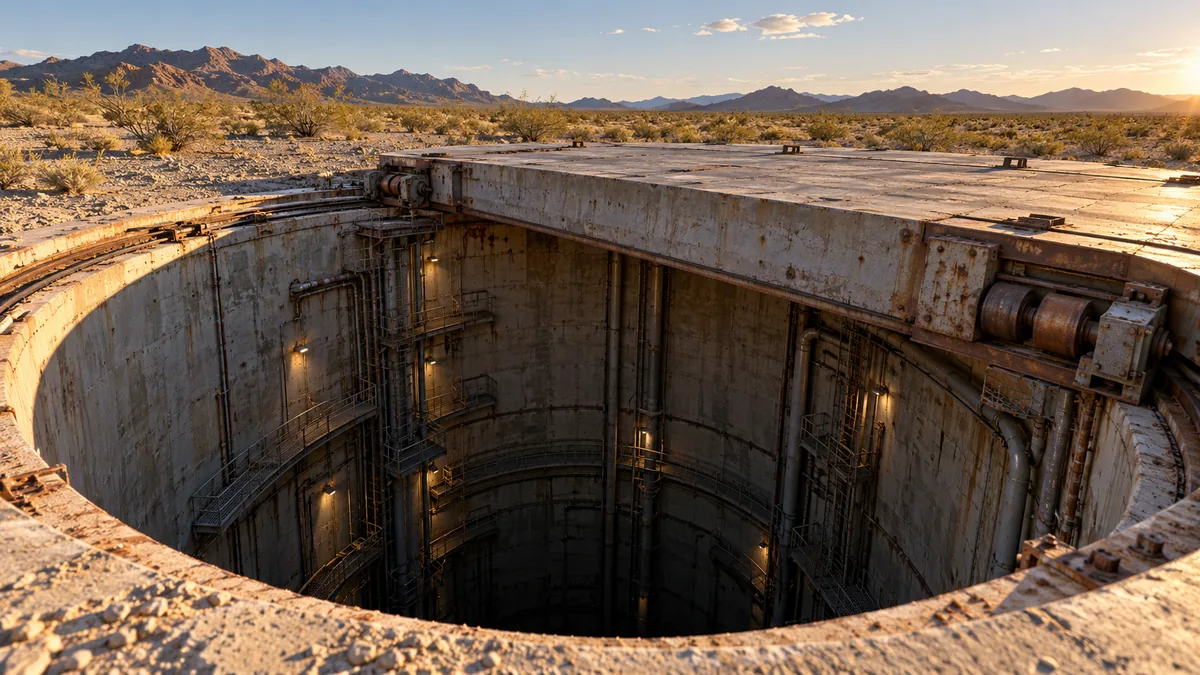
What Is a Missile Silo? A Look Inside the Last Titan II Site
The short answer: A missile silo is a deep, vertical, blast-hardened shaft built underground to store an intercontinental ballistic missile (ICBM) and launch it on command. The missile stands upright inside, under a heavy sliding door. A crew in a nearby underground launch control center watches over it and, if ordered, launches it. The whole point of burying it is survival: a silo is built to ride out a nearby nuclear blast so the missile can still be fired back.
The word “silo” often gets used for the entire site, but a working missile site had several connected parts. The easiest way to understand them is to walk through one that still exists. Launch Complex 571-7, south of Tucson in Green Valley, Arizona, is the last of the 54 Titan II missile sites that stood on alert across the United States from 1963 to 1987. Today it is the Titan Missile Museum.
The parts of a missile silo site
A Titan II complex was a small underground base, not just a hole in the ground. From the surface down, these were the main pieces:
- Access portal. The only regular way in: a stairwell and freight elevator about 35 feet deep, with 55 steps. It included an “entrapment area” where anyone arriving was held until their entry authority was confirmed.
- Blast lock. At the foot of the stairs, two sets of 3-ton steel blast doors and 3-foot-thick concrete and steel walls protected the crew from nearby detonations, intruders and hazards in the silo.
- Launch control center. A three-level control center. Level 1 held crew quarters (bunks, kitchen, lavatory). Level 2 held the launch controls. Level 3 held communications gear, backup power, emergency rations and an escape hatch.
- Cableways. Two steel tunnels, more than 200 feet long in total, carried the cables that linked the control center to the missile.
- Missile silo and launch duct. The launch duct is the shaft the missile stands in. Around it, the silo’s eight equipment levels (plus a sump) housed everything needed to keep the missile ready and launch it. Daily crew inspections of that equipment took three to four hours.
- Silo closure door. A 740-ton door covered the launch duct against blast, radiation and weather, according to the National Park Service. It slid open only for launch.
You can click through each of these areas on the museum’s interactive map of Launch Complex 571-7, which also shows which parts are seen on tour.
How deep is a missile silo?
It depends on the missile. Bigger missiles needed deeper, wider shafts:
| Silo | Launch shaft depth | Shaft diameter |
|---|---|---|
| Titan II (Launch Complex 571-7) | 146 feet | 26 feet |
| Minuteman (Delta-09, South Dakota) | 80 feet | 12 feet |
The Titan II was about 103 feet long and 10 feet wide, the largest land-based missile the United States ever deployed. The Minuteman missiles that followed are much smaller, so their launch tubes are roughly half as deep, per the National Park Service’s Delta-09 page. The crew areas sat shallower than the missile itself. At the Titan site, the access portal reaches about 35 feet down.
How a Titan II silo launched a missile
Two design choices made the Titan II silo fast. First, it launched straight out of the silo rather than being raised to the surface first, as earlier Atlas F and Titan I missiles were. Second, its propellants were storable and hypergolic: the fuel and oxidizer stayed loaded in the missile indefinitely and ignited on contact, with no spark needed. That let the missile sit fully fueled for years.
The result: from the turn of the launch keys to lift-off took under a minute. The museum puts it at 58 seconds.
People were the other half of the system. Each site was staffed 24 hours a day, 365 days a year, by a four-person missile combat crew: two officers and two enlisted technicians working 24-hour shifts called alerts. At least two crew members had to be in the launch control center at all times, and one had to be an officer. No single person could launch the missile. For more on the program, see the museum’s page on Titan II history and specifications.
The Titan II was built for a 10-year deployment and served more than twice that. It was retired between 1982 and 1987 to make way for newer systems such as the MX Peacekeeper.
Titan II vs. Minuteman III silos
The Titan II and Minuteman are the two silo systems visitors ask about most. Here is how they compare:
| Titan II | Minuteman III | |
|---|---|---|
| Years in service | 1963–1987 | Entered the force in 1970; still on alert |
| Fuel | Storable liquid propellants | Three solid-fuel rocket motors |
| Sites | 54, in groups of 18 around three bases | Spread across not fewer than 450 silos at three bases |
| Crew location | Four-person crew in an underground control center at each missile site | Launch control centers each oversee a group of silos, such as the 10 silos of Delta Flight in South Dakota |
| Where you can see one | Titan Missile Museum, Green Valley, Arizona | Minuteman Missile National Historic Site, South Dakota |
The biggest practical difference is the crew arrangement. A Titan II crew sat beside its one missile. A Minuteman crew sits in a launch control center linked by hardened cable to several remote silos.
Where are US missile silos today?
The Titan II sites were clustered around three bases: Davis-Monthan Air Force Base in Arizona, Little Rock AFB in Arkansas, and McConnell AFB in Kansas. Only Launch Complex 571-7 was preserved; the rest were deactivated.
Today’s active US ICBMs are all Minuteman III missiles. According to the Congressional Research Service’s primer on the Sentinel ICBM (May 2026), they are deployed across not fewer than 450 hardened silos run from F.E. Warren, Malmstrom and Minot Air Force Bases, in North Dakota, Montana, Wyoming, Colorado and Nebraska. The same report says the Air Force now plans to build new silos for the replacement LGM-35A Sentinel missile rather than reuse the old ones, with an initial capability targeted for the early 2030s.
Can you visit a missile silo?
Yes. At the Titan Missile Museum you can go inside a complete Titan II complex. The 45-minute guided underground missile silo tour takes you 35 feet down through the blast doors to the launch control center, where you watch a simulated launch. Then you walk the cableway to the silo for a close look at the missile in its launch duct.
A few things to know before you go:
- Tours are by online reservation. Each tour is limited to 26 visitors, so book ahead for your preferred time.
- The underground tour has 55 stairs each way and no elevator. You also need to be able to stand for about 45 minutes.
- There is a no-stairs option. A self-guided topside ticket lets you see the missile’s engine, the security alarm systems and site vehicles, and look down into the 146-foot silo through the open door.
The door is open for a reason. When the site became a museum, holes were cut in each of the missile’s propellant tanks and in the heat shield of its reentry vehicle. The missile was then displayed on the surface for 30 days so satellites could confirm it was no longer operational. After it went back into the launch duct, the silo door was fixed permanently in its half-open position, with a window over the opening for visitors and satellites alike. The museum opened on May 21, 1986, and the site was named a National Historic Landmark in April 1994.
Missile silo FAQ
What is a nuclear missile silo?
It is the same thing as a missile silo: an underground, hardened launcher for a nuclear-armed ICBM. The Titan II at the museum carried a 9-megaton W-53 warhead when it was on alert. The museum’s missile is inert.
What does a missile silo look like?
From above, surprisingly plain: a fenced surface area with a massive silo door, plus antennas, vents and security sensors. Underground, a Titan II silo is a round concrete shaft lined with steel work platforms, with the missile standing in the middle.
How many Titan II missile silos were there?
Fifty-four, in three groups of 18. Arizona’s 18 surrounded Davis-Monthan AFB in Tucson.
What replaced the Titan II?
The Titan II was deactivated in 1982–1987 as part of a modernization plan that included the MX Peacekeeper. Today the Minuteman III is the only US ICBM in service.
Is the Titan missile still active?
No. The last Titan II came off alert in 1987. The missile at the museum has been disabled, and the changes made so satellites could confirm it, like the half-open silo door, are still visible today.
See a real missile silo near Tucson
Reading about a silo is one thing; standing in the launch control center 35 feet underground is another. The Titan Missile Museum is in Green Valley, south of Tucson: take I-19 south to Duval Mine Road (exit 69) and follow the signs.
Book Your Silo Tour or call (520) 934-1863.